Posts Tagged ‘ubicomp’

Report on Fundamentals of Ubicomp course

Posted in course, teaching, ubicomp, unh ece on July 13th, 2010 by Andrew – Be the first to comment

During the spring 2010 semester I taught a new course entitled Ubiquitous Computing Fundamentals. The term ubiquitous computing refers to the model of computing in which computers are embedded in everyday objects and become part of everyday activities. As the name implies, this course was designed as an introduction to this exciting field of study.

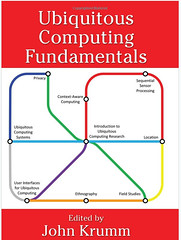
In this course I used the excellent new ubicomp textbook [1] edited by John Krumm. I highly recommend this book to anyone starting out in the field of ubicomp. Specifically, I like two aspects of the book. First, the team of contributors assembled by John provides a comprehensive introduction to the myriad topics that make up the ubicomp field. The fact that ubicomp is an interdisciplinary field is exciting, but getting an overview of the field may seem like a daunting task. The textbook provides this overview. Second, paraphrasing Aaron Quigley‘s assessment of his chapter [2], the book provides “an entry point” to the world of conducting research in general, and ubicomp research in particular. The contributors discuss the tools used in various aspects of ubicomp research, from prototyping, to user studies, to data processing. The individual chapters help the reader formulate research questions and steps, and provide valuable tips on how to report on results. 

The course covered three topic areas:

  • History of ubicomp. The semester started with Weiser’s seminal paper [3] and with a textbook chapter introducing ubicomp by Roy Want, one of Weiser’s collaborators at Xerox PARC.
  • Building ubicomp systems. We discussed various aspects of creating ubicomp systems, from writing always-on software, to privacy, to conducting laboratory and field experiments.
  • The user experience. As this is my research focus, we spent a considerable amount of time discussion user interactions with ubicomp systems, from speech interactions, to multi-touch tables, to tangible user interfaces.

I found that an excellent way to discuss ubicomp topics is to take advantage of research videos posted online. We viewed many such videos and this led to productive discussions. We also benefited from excellent talks by Marko PopovicBret Harsham and Albrecht Schmidt.

I felt that the course was a success. Students indicated that they liked the course and thought that it was useful. The course also allowed students to express themselves creatively through the course project. The results were impressive and I’ll end this post with an example. The video below is the work of UNH ECE seniors Amy Schwarzenberg and Kyle Maroney (both graduated in May). Amy and Kyle explored user interactions with a Microsoft Surface multi-touch table.

References

[1] John Krumm (editor), “Ubiquitous Computing Fundamentals,” CRC Press, 2010

[2] Aaron Quigley, “From GUI to UUI: Interfaces for Ubiquitous Computing,” in John Krumm (editor), “Ubiquitous Computing Fundamentals,” CRC Press, 2010

[3] Mark Weiser, “The Computer for the 21st century,” Scientific American, pp. 94-10, September 1991

Albrecht Schmidt visit to UNH

Posted in Project54, hci, talk, ubicomp, visit on May 9th, 2010 by Andrew – Be the first to comment

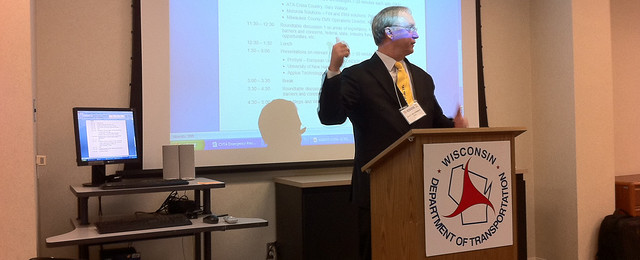
Last month (April 16) Albrecht Schmidt visited UNH and the Project54 lab. Albrecht gave an excellent talk introducing some of the research problems in pervasive computing and specifically touching on the latest results from his lab, which were just published at CHI 2010 [1, 2]. I was especially interested in the work on helping users find the last place of interest on a map quickly. Albrecht and colleagues track the user’s gaze and when the user looks away, they place a marker (or gazemark) on the map. When the user looks back at the map she can start where she left off: at the place of the marker. Clearly this could be very useful when looking at GPS maps in a car. In such a situation the driver has to keep going back and forth between the map and the road and you want to minimize the time spent looking at the map (the road being the more important thing to look at!). The gazemarks introduced by Albrecht’s group may help. It would be interesting to conduct a driving simulator study with gazemarks.

After the talk Albrecht spent about an hour with students from the Project54 lab and those in my Ubicomp Fundamentals course. This was a more intimate setting for conversations about Albrecht’s research. Finally, Project54 staff and students spent a couple of hours discussing Project54 research with Albrecht – our work on handheld computers, on driving simulator-based investigations of in-car user interfaces and our budding efforts in multi-touch table interaction.

I am grateful to the UNH Provost’s Office for helping to fund Albrecht’s visit through a grant from the Class of 1954 Academic Enrichment Fund.

References

[1] Dagmar Kern, P. Marshall and Albrecht Schmidt, ” Gazemarks: gaze-based visual placeholders to ease attention switching,” CHI 2010

[2] Alireza Sahami Shirazi, Ari-Heikki Sarjanoja, Florian Alt, Albrecht Schmidt, and Jonna Häkkilä, J. “Understanding the impact of abstracted audio preview of SMS,” CHI 2010