automotive

Visit to FTW, Vienna

Posted in automotive, eye tracking, ftw, navigation, talk, visit on June 16th, 2010 by Andrew – Be the first to comment

On June 4, 2010 I visited the Telecommunications Research Center Vienna (FTW). My host was Peter Froehlich, Senior Researcher in FTW’s User-Centered Interaction area of activity. Peter and I met at the CHI SIG meeting on automotive user interfaces [1] that I helped organize.

Peter and his colleagues are investigating automotive navigation aids and are currently preparing for an on-road study. I’m happy to report that this study will utilize one of our eye trackers. My visit provided an opportunity for us to discuss this upcoming study and how the eye tracker may be useful in evaluating the research hypotheses. Part of this discussion was a Telecommunications Forum talk I gave – see the slides below:

I want to thank Peter and his colleagues at FTW for hosting me and I’m looking forward to our upcoming collaboration. I also want to thank FTW for providing funding for my visit.

References

[1] Albrecht Schmidt, Anind L. Dey, Andrew L. Kun, Wolfgang Spiessl, “Automotive User Interfaces: Human Computer Interaction in the Car,” CHI 2010 Extended Abstracts

Project54 on front page of New York Times

Posted in Project54, automotive, media, speech, unh, user interface on March 11th, 2010 by Andrew – 1 Comment

In a front page article of the March 11, 2010 edition of the New York Times Matt Richtel discusses in-vehicle electronic devices used by first responders. Based on a number of interviews, including one with me, Matt gets the point across that interactions with in-vehicle devices can distract first responders from the primary task for any driver: driving. The personal accounts from first responders are certainly gripping. Thanks Matt for bringing this issue to the public.

Enter Project54. According to Matt “[r]esearchers are working to reduce the risk.” He goes on to describe UNH’s Project54 system which allows officers to issue voice commands in order to interact with in-car electronic devices. This means officers can keep their eyes on the road and their hands on the wheel. The article includes praise for the Project54 system by Captain John G. LeLacheur of the New Hampshire State Police. The Project54 system was developed in partnership with the NHSP and almost every NHSP cruiser has the Project54 system installed.

Both the print and the online versions of the article begin with a picture of the Project54 in-car system. This great picture was taken by Sheryl Senter and it shows Sergeant Tom Dronsfield of the Lee, NH Police Department in action.

Alex Shyrokov defends PhD

Posted in automotive, defense, hci, phd, unh ece on March 2nd, 2010 by Andrew – Be the first to comment

Two weeks ago my student Alex Shyrokov defended his PhD dissertation. Alex was interested in human-computer interaction for cases when the human is engaged in a manual-visual task. In such situations a speech interface appears to be a natural way to communicate with a computer. Alex was especially interested in multi-threaded spoken HCI. In multi-threaded dialogues the conversants switch back and forth between multiple topics.

How should we design a speech interface that will support multi-threaded human-computer dialogues when the human is engaged in a manual-visual task? In order to begin answering this question Alex explored spoken dialogues between two human conversants. The hypothesis is that a successful HCI design can mimic some aspects of human-human interaction.

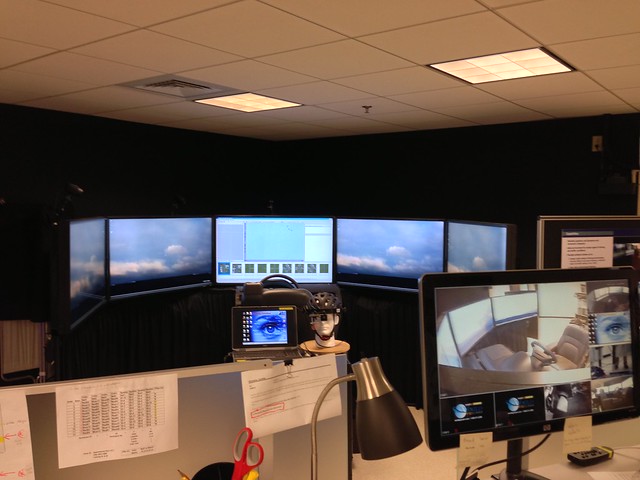
In Alex’s experiments one of the conversants (the driver) operated a simulated vehicle while the other (an assistant) was only engaged in the spoken dialogue. The conversants were engaged in an ongoing and in an interrupting spoken task. Alex’s dissertation discusses several interesting findings, one of which is that driving performance is worse during and after the interrupting task. Alex proposes that this is due to a shift in the driver’s attention away from driving and to the spoken tasks. The shift in turn is due to the perceived urgency of the spoken tasks – as the perceived urgency increases the driver is more likely to shift her attention away from driving. The lesson for HCI design is to be very careful in managing the driver’s perceived urgency when interacting with devices in the car.

Alex benefited tremendously from the help of my collaborator on this research Peter Heeman. Peter provided excellent guidance throughout Alex’s PhD studies for which I am grateful. Peter and I plan to continue working with Alex’s data. The data includes transcribed dialogues, videos, driving performance as well as eye tracker data. I am especially interested in using the eye tracker’s pupil diameter measurements to estimate cognitive load as we have done in work lead by Oskar Palinko [1].

References

[1] Oskar Palinko, Andrew L. Kun, Alexander Shyrokov, Peter Heeman, “Estimating Cognitive Load Using Remote Eye Tracking in a Driving Simulator,” ETRA 2010

Automotive user interfaces SIG meeting to be held at CHI 2010

Posted in automotive, conference, hci, paper on February 1st, 2010 by Andrew – Be the first to comment

There will be a special interest group (SIG) meeting on automotive user interfaces at CHI 2010. The lead author of the paper describing the aims of the SIG [1] is Albrecht Schmidt and the list of coauthors includes Anind Dey, Wolfgang Spiessl and me. CHI SIGs are 90 minute scheduled sessions during the conference. They are an opportunity for researchers with a common interest to meet face-to-face and engage in dialog.

Our SIG deals with human-computer interaction in the car. This is an exciting field of study that was the topic of a CHI 2008 SIG [2] as well as the AutomotiveUI 2009 conference [3], and the AutomotiveUI 2010 CFP will be posted very soon. In the last several years human-computer interaction in the car has increased for two main reasons. One, many cars now come equipped with myriad electronic devices such as displays indicating power usage and advanced driver assistance systems. Second, users (drivers and passengers) bring mobile devices to cars. The list of these brought-in mobile devices is long but personal navigation devices and mp3 players are probably the most common ones.

At the SIG we hope to discuss user interface issues that are the result of having all of these devices in cars. Some of the questions are:

  • How can we reduce (or eliminate) driver distraction caused by the in-car devices?
  • Can driver interactions with in-car devices actually improve driving performance?
  • Can users take advantage of novel technologies, such as streaming videos from other cars?
  • How do we build interfaces that users can trust and will thus actually use?
  • How can car manufacturers, OEMs, brought-in device manufacturers and academia collaborate in envisioning, creating and implementing automotive user interfaces?

The 2008 CHI SIG [2] attracted over 60 people and we’re hoping for similar (or better!) turnout.

References

[1] Albrecht Schmidt, Anind L. Dey, Andrew L. Kun, Wolfgang Spiessl, “Automotive User Interfaces: Human Computer Interaction in the Car,” CHI 2010 Extended Abstracts (to appear)

[2] D. M. Krum, J. Faenger, B. Lathrop, J. Sison, A. Lien, “All roads lead to CHI: interaction in the automobile,” CHI 2008 Extended Abstracts

[3] Albrecht Schmidt, Anind Dey, Thomas Seder, Oskar Juhlin, “Proceedings of the 1st International Conference on Automotive User Interfaces and Interactive Vehicular Applications, 2009″