Posts Tagged ‘unh ece’

Report on Fundamentals of Ubicomp course

Posted in course, teaching, ubicomp, unh ece on July 13th, 2010 by Andrew – Be the first to comment

During the spring 2010 semester I taught a new course entitled Ubiquitous Computing Fundamentals. The term ubiquitous computing refers to the model of computing in which computers are embedded in everyday objects and become part of everyday activities. As the name implies, this course was designed as an introduction to this exciting field of study.

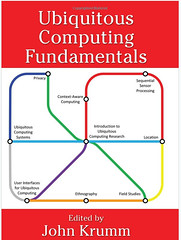
In this course I used the excellent new ubicomp extbook [1] edited by John Krumm. I highly recommend this book to anyone starting out in the field of ubicomp. Specifically, I like two aspects of the book. First, the team of contributors assembled by John provides a comprehensive introduction to the myriad topics that make up the ubicomp field. The fact that ubicomp is an interdisciplinary field is exciting, but getting an overview of the field may seem like a daunting task. The textbook provides this overview. Second, paraphrasing Aaron Quigley‘s assessment of his chapter [2], the book provides “an entry point” to the world of conducting research in general, and ubicomp research in particular. The contributors discuss the tools used in various aspects of ubicomp research, from prototyping, to user studies, to data processing. The individual chapters help the reader formulate research questions and steps, and provide valuable tips on how to report on results. 

The course covered three topic areas:

  • History of ubicomp.The semester started with Weiser’s seminal paper [3] and with a textbook chapter introducing ubicomp by Roy Want, one of Weiser’s collaborators at Xerox PARC.
  • Building ubicomp systems.We discussed various aspects of creating ubicomp systems, from writing always-on software, to privacy, to conducting laboratory and field experiments.
  • The user experience. As this is my research focus, we spent a considerable amount of time discussion user interactions with ubicomp systems, from speech interactions, to multi-touch tables, to tangible user interfaces.

I found that an excellent way to discuss ubicomp topics is to take advantage of research videos posted online. We viewed many such videos and this led to productive discussions. We also benefited from excellent talks by Marko PopovicBret Harsham and Albrecht Schmidt.

I felt that the course was a success. Students indicated that they liked the course and thought that it was useful. The course also allowed students to express themselves creatively through the course project. The results were impressive and I’ll end this post with an example. The video below is the work of UNH ECE seniors Amy Schwarzenberg and Kyle Maroney (both graduated in May). Amy and Kyle explored user interactions with a Microsoft Surface multi-touch table.

References

[1] John Krumm (editor), “Ubiquitous Computing Fundamentals,” CRC Press, 2010

[2] Aaron Quigley, “From GUI to UUI: Interfaces for Ubiquitous Computing,” in John Krumm (editor), “Ubiquitous Computing Fundamentals,” CRC Press, 2010

[3] Mark Weiser, “The Computer for the 21st century,” Scientific American, pp. 94-10, September 1991

Return visit to Budapest University of Technology and Economics (BUTE)

Posted in bute, ceps, talk, unh, unh ece, visit on June 17th, 2010 by Andrew – 1 Comment

On June 7 and 8, 2010 I visited the Budapest University of Technology and Economics (BUTE) for the second time in ten months. As with my last visit I went to discuss the BUTE-CEPS exchange program.

During this visit I met six people who have been involved in organizing different aspects of the exchange program. My host was Eszter Kiss, the Program Director of the Information Center for Engineering Programs in English (ICEPE). For UNH/CEPS students, staff and faculty, she is the Hungarian face of the exchange program. Eszter and I primarily talked about the fact that, starting in 2011, UNH ECE exchange students will spend the spring semester in Budapest. Other CEPS students will remain on the fall-in-Budapest schedule.

Eszter organized two meetings for me with BUTE leaders. The first one was with Dr. Peter Moson, Vice-Rector for International Relations (the Vice-Rector position at BUTE is equivalent to the Vice President position at a US university). Ildiko Varga, the head of the BUTE Erasmus and Exchange Office was also present at this meeting. Dr. Moson expressed his full support for a vibrant relationship between BUTE and CEPS. On a personal note it was great to see Dr. Moson who I met during his visit to UNH last year. It was also nice to talk to Ms. Varga who went to graduate school and taught mathematics at Purdue.

The second meeting organized by Eszter was with Dr. Gabor Stepan. Dr. Stepan, a member of the Hungarian Academy of Sciences (HAS), is the Dean of the BUTE Faculty of Mechanical Engineering, the ICEPE’s parent unit. Dr. Stepan expressed his full support for the BUTE-CEPS exchange program. Again on a personal note, it was exciting for me to visit the BUTE Faculty of ME where my father received his BS ME a long time ago. Dr. Stepan also spent some time telling me about BUTE’s history, including facts and anecdotes about BUTE’s Nobel-prize winning alumni.

While the meetings with Drs Stepan and Moson and with Ms. Varga primarily dealt with the overall BUTE-CEPS relationship, I also had a chance to work on issues related to UNH ECE directly with the BUTE unit that hosts ECE students. Specifically, Dr. Moson introduced me to Dr. Balint Kiss, the person in charge of the English language education at the Faculty of Electrical Engineering and Informatics. This is the BUTE unit that hosts UNH ECE exchange students and Dr. Kiss will be my primary contact in determining courses for our students to take while at BUTE. The meeting with Dr. Kiss was also an opportunity to catch up with Dr. Peter Arato. Dr. Arato, who is also a HAS member, has strong ties to the UNH ECE department having collaborated extensively with UNH ECE professor Andrzej Rucinski.

In addition to all these productive meetings I had a chance to give a talk to BUTE students interested in the exchage program. Seven prospective students attended, several of them interested in coming to the UNH ECE department – I hope we’ll see them here soon.

I would like to thank Eszter Kiss for organizing my visit (on very short notice). I would also like to thank the BUTE faculty, staff and students who took time to meet with me. Finally, I would like to acknowledge the UNH ECE Department and the CEPS Dean’s office who jointly funded this visit.

For pictures about my trips to Budapest visit my Flickr page.

Alex Shyrokov defends PhD

Posted in automotive, defense, hci, phd, unh ece on March 2nd, 2010 by Andrew – Be the first to comment

Two weeks ago my student Alex Shyrokov defended his PhD dissertation. Alex was interested in human-computer interaction for cases when the human is engaged in a manual-visual task. In such situations a speech interface appears to be a natural way to communicate with a computer. Alex was especially interested in multi-threaded spoken HCI. In multi-threaded dialogues the conversants switch back and forth between multiple topics.

How should we design a speech interface that will support multi-threaded human-computer dialogues when the human is engaged in a manual-visual task? In order to begin answering this question Alex explored spoken dialogues between two human conversants. The hypothesis is that a successful HCI design can mimic some aspects of human-human interaction.

In Alex’s experiments one of the conversants (the driver) operated a simulated vehicle while the other (an assistant) was only engaged in the spoken dialogue. The conversants were engaged in an ongoing and in an interrupting spoken task. Alex’s dissertation discusses several interesting findings, one of which is that driving performance is worse during and after the interrupting task. Alex proposes that this is due to a shift in the driver’s attention away from driving and to the spoken tasks. The shift in turn is due to the perceived urgency of the spoken tasks – as the perceived urgency increases the driver is more likely to shift her attention away from driving. The lesson for HCI design is to be very careful in managing the driver’s perceived urgency when interacting with devices in the car.

Alex benefited tremendously from the help of my collaborator on this research Peter Heeman. Peter provided excellent guidance throughout Alex’s PhD studies for which I am grateful. Peter and I plan to continue working with Alex’s data. The data includes transcribed dialogues, videos, driving performance as well as eye tracker data. I am especially interested in using the eye tracker’s pupil diameter measurements to estimate cognitive load as we have done in work lead by Oskar Palinko [1].

References

[1] Oskar Palinko, Andrew L. Kun, Alexander Shyrokov, Peter Heeman, “Estimating Cognitive Load Using Remote Eye Tracking in a Driving Simulator,” ETRA 2010

Promoting the CEPS-BUTE Exchange Program

Posted in bute, ceps, presentation, unh, unh ece on November 10th, 2009 by Andrew – Be the first to comment

In an effort to promote the CEPS-BUTE exchange program I gave the following presentation to two similar audiences here at UNH. Last Monday Kent Chamberlin hosted me in his ECE 401 class (the introductory ECE course) and I had a chance to talk to about 75 ECE freshmen. Today I gave the presentation to Bob Henry’s TECH 400 students (TECH 400 introduces the CEPS majors to CEPS undeclared students).

View more presentations from Andrew Kun.

My main point was this: spending a semester abroad gives students a competitive advantage because it proves that they can adapt to change. Of course spending a semester in Europe allows students to travel and I spent some time promoting my favorite travel guide author, Rick Steves :)

NSF SBIR review panel

Posted in nsf, proposal, review, sbir, unh ece on November 2nd, 2009 by Andrew – Be the first to comment

On Thursday I participated in a Phase II National Science Foundation Small Business Innovation Research (NSF SBIR) panel. While I’ve been to Phase I panels before, this was my first Phase II panel. In Phase I companies can request up to $150,000 for 6 months to a year. A company that receives a Phase I award, and successfully delivers on its grant, is eligible to compete in Phase II with a proposal for up to $500,000 for two years. 

The one thing that always strikes me at the SBIR panels is that proposals have to make a good business case. Panels include both technical experts and business experts and a proposal has to clear the bar with both sets in order to be recommended for funding. I’ve always taken it for granted that an NSF proposal (SBIR or scientific) should make a good argument for why the technology or scientific innovation is worth funding. However, before my involvement in the SBIR review process, I didn’t really think much about the business case to be made when requesting funding for a business venture. In this respect I’m hardly alone: engineers usually don’t spend much time exploring the business side of running a business. At the UNH ECE department we’re looking into alleviating this problem through the involvement of Brad Gillespie in our senior project courses. Brad is a UNH ECE alumnus, Microsoft veteran and business strategy consultant. Read about Brad’s last visit to UNH ECE and check back for more on this in a future post.

So, if you’re a technical person planning to submit an SBIR proposal (note that many federal agencies run SBIR programs, not just the NSF), my advice is this: bring in people who can help you think through (and coherently present in the proposal) a business plan for your venture. Without a compelling business plan your proposal will not be funded.